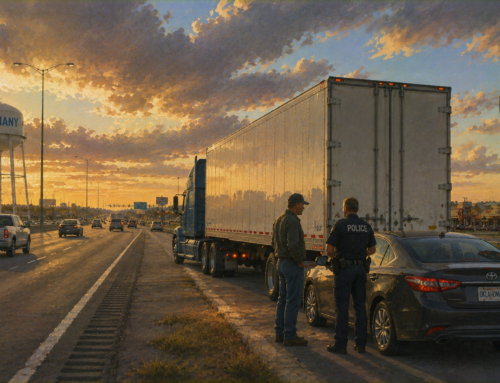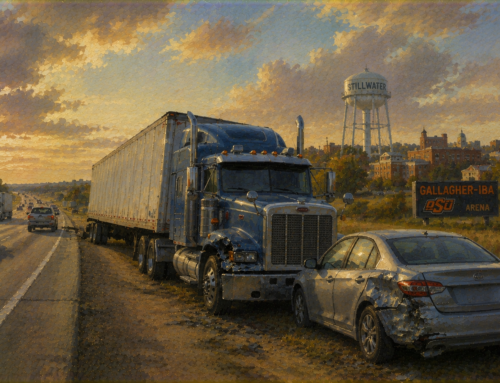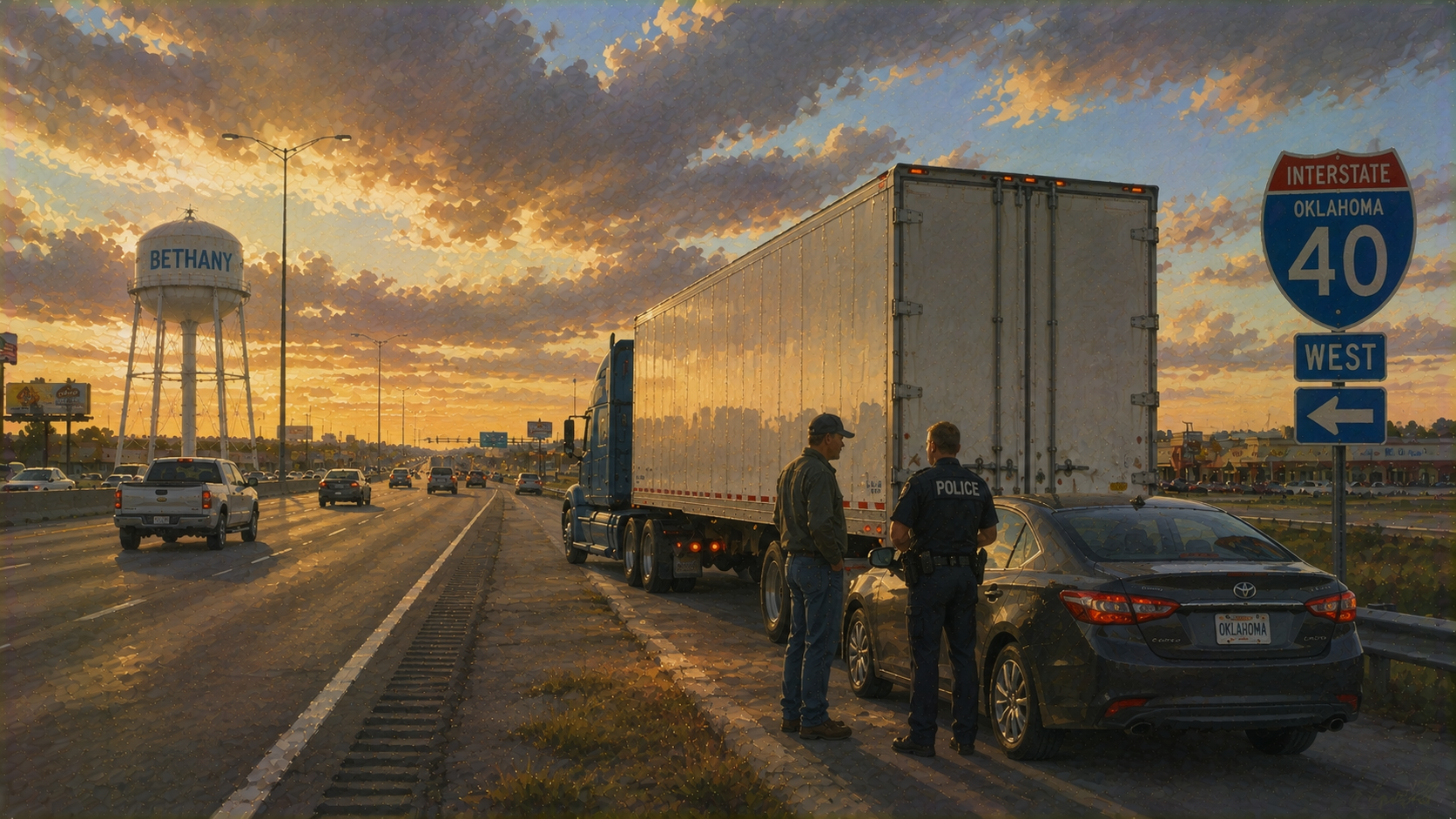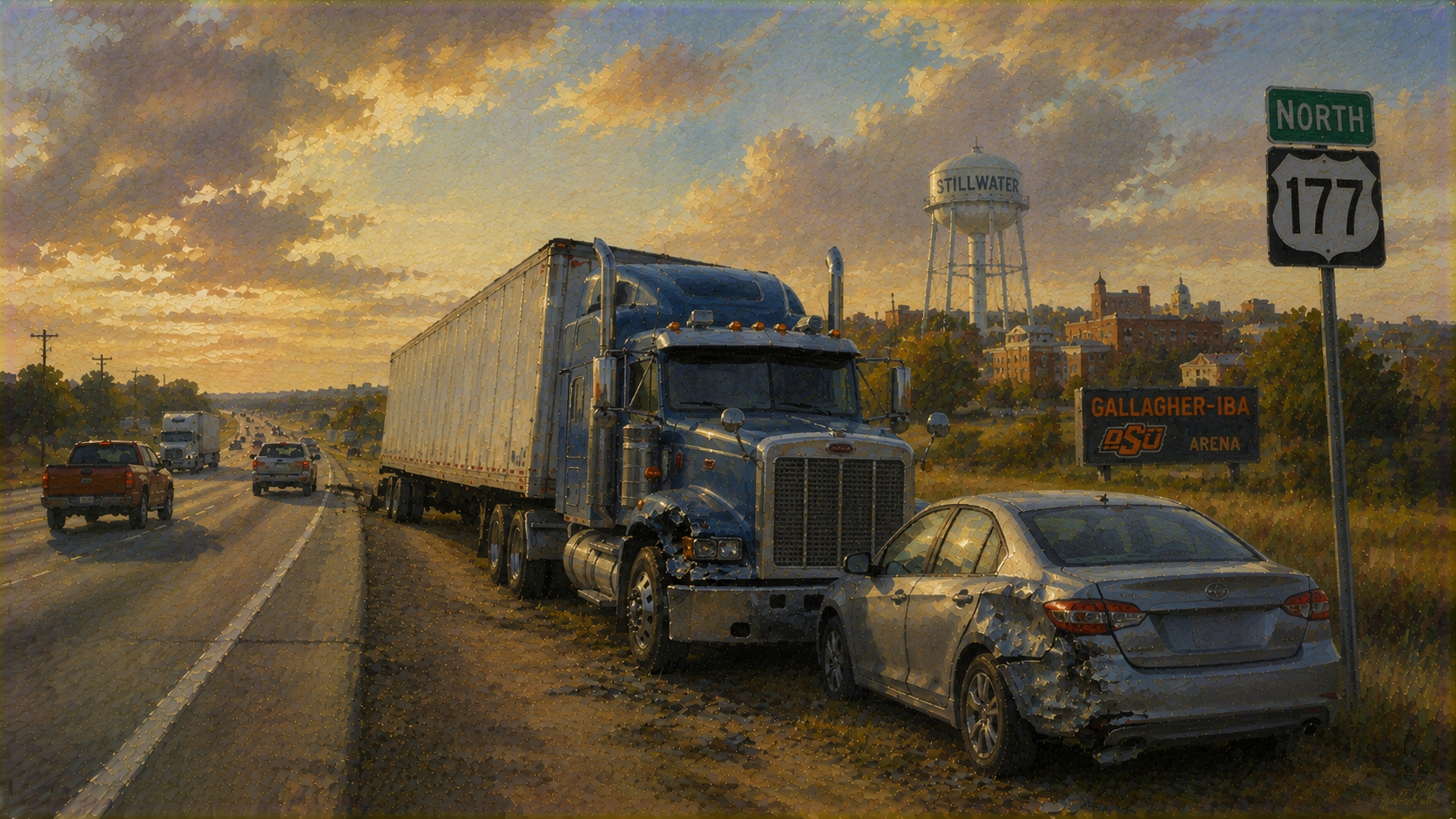
Interstate 35 cuts through the eastern edge of Midwest City, connecting Oklahoma County to the broader north-south freight corridor that runs from the Texas border to Kansas and beyond. For residents of Midwest City and the surrounding eastern Oklahoma County communities, I-35 is both a daily commuter route and a highway that carries a relentless flow of commercial truck traffic at all hours. When a semi-truck is involved in a serious accident on this stretch, the legal questions that follow are almost never simple — and the number of parties who may share responsibility is almost never just one.
If you were injured in a semi wreck on I-35 near Midwest City, understanding the multi-party nature of these cases is one of the most important things you can do before making any decisions about your claim.
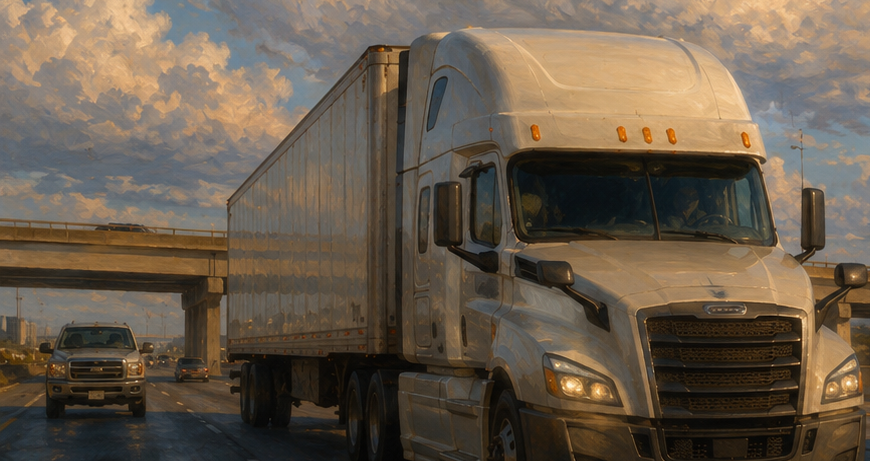
Why I-35 Through Eastern Oklahoma County Creates Semi Wreck Risk
The I-35 corridor through Midwest City and the surrounding eastern Oklahoma County area carries the full weight of one of the nation’s busiest north-south commercial freight routes. Commercial trucks moving between Texas and the Oklahoma City metro distribution network use this stretch constantly, and the characteristics of the highway near Midwest City create conditions where serious accidents are a persistent and predictable risk.
Contributing factors include:
- Heavy commercial freight volume where I-35 connects to the Oklahoma City metro interchange network — one of the most complex and congested interchange environments in the state
- Merging and lane-change conflicts as commercial traffic navigates the I-35 and I-240 interchange system near Midwest City
- Driver fatigue among long-haul operators on extended north-south runs who reach the Oklahoma City area hours into a shift
- High-speed differential between commercial trucks and passenger vehicles during periods of variable traffic flow near metro interchanges
- Tinker Air Force Base traffic adding significant vehicle density to the corridors connecting to I-35 near Midwest City during base shift changes
- Mechanical failures — particularly brake system and tire issues — that become catastrophic when a loaded trailer is involved at interstate speeds
When a fully loaded commercial truck collides with a passenger vehicle on this corridor, the consequences for the occupants of that passenger vehicle are frequently severe and life-altering.
What Multiple Parties Means — and Why It Matters for Your Claim
The defining characteristic of serious semi wreck cases on I-35 that separates them from standard car accident claims is not just the severity of the injuries — it is the number of entities that may share legal responsibility for the crash. In a typical two-car accident, liability begins and ends with the at-fault driver. In a commercial trucking case, that analysis is only the starting point.
Depending on how the accident on I-35 occurred and the commercial arrangements underlying the truck’s operation, potentially liable parties may include:
- The truck driver — for negligent driving, speeding, distracted or impaired driving, or violations of federal hours-of-service regulations that establish how long a driver can operate before mandatory rest
- The trucking company — for negligent hiring or inadequate training of the driver, failure to enforce safety compliance and hours-of-service rules, unrealistic delivery scheduling that pressures drivers to exceed legal limits, or inadequate supervision of driver conduct on the route
- The owner of the tractor — which in commercial trucking is frequently a separate entity from the company that dispatched the load, particularly where owner-operator leasing arrangements are involved
- The owner of the trailer — which may be yet another separate entity, particularly in intermodal or third-party logistics arrangements common in the industry
- A cargo company or freight broker — if improperly loaded, unevenly distributed, or overweight freight contributed to the crash by shifting during transit, affecting the truck’s handling, or causing the driver to lose control
- A maintenance contractor — if a mechanical failure such as brake failure or tire blowout resulted from inadequate inspection, deferred maintenance, or negligent repair work
- A truck or component manufacturer — in cases where a defective part contributed to the accident independent of how well the vehicle was otherwise maintained and inspected
Each of these parties typically carries separate insurance coverage with separate policy limits. Identifying all of them — and ensuring all potential compensation sources are pursued — is one of the most consequential things an experienced semi wreck attorney does in the early stages of a case.
One Claim, Multiple Sources — How This Works in Practice
The practical implication of multi-party liability in an I-35 Midwest City semi wreck case is that your claim is not limited to what a single insurance policy will pay. When multiple parties share responsibility for a crash, multiple insurance policies may be available to fund your recovery — and in cases involving catastrophic injuries, that difference can be substantial.
This is one reason why commercial trucking cases often produce significantly higher compensation than standard car accident claims — not just because commercial carriers are required to carry higher policy limits than individual drivers, but because there may be multiple policy limits available across multiple responsible parties.
It is also one reason why these cases require experienced legal representation from the outset. Identifying every liable party, understanding the commercial arrangements that connect them, and pursuing claims against all of them simultaneously requires knowledge of federal trucking regulations, commercial insurance structures, and the litigation strategies that trucking companies and their insurers use to shift blame and limit exposure.
Evidence That Establishes Who Is Responsible — and Why It Disappears Fast
Proving which parties are liable in a Midwest City I-35 semi wreck case depends on evidence that is largely controlled by the trucking company and its affiliated entities — and much of it has a very short shelf life. Key evidence includes:
- Electronic logging device data establishing the driver’s hours and potential fatigue violations — subject to automatic overwriting within 30 days
- The truck’s event data recorder capturing speed, braking, and steering inputs in the moments before impact
- Lease and ownership agreements establishing the relationship between the driver, the carrier, the tractor owner, and the trailer owner
- Cargo manifests and loading documentation revealing whether freight was properly secured and within legal weight limits
- Driver qualification files and training records
- Vehicle maintenance and inspection logs
- Post-accident drug and alcohol testing results
- Onboard camera footage if the truck was equipped with cab-facing or road-facing cameras
A legal hold letter sent promptly after the accident can compel all relevant parties to preserve this material. Without it, evidence that could be decisive to your case may be permanently lost within weeks.
What Compensation May Be Available
Semi wreck injuries on I-35 near Midwest City frequently produce losses that extend well beyond immediate medical expenses. Compensation in a serious semi wreck case may include:
- Emergency medical care, surgery, and hospitalization
- Long-term rehabilitation and ongoing treatment costs
- Lost wages during recovery and reduced future earning capacity
- Pain and suffering and loss of enjoyment of life
- Property damage to your vehicle
- Future medical costs for permanent or extended injuries
- Wrongful death damages if the accident resulted in the loss of a family member
When multiple liable parties are identified and all available compensation sources are pursued, the total recovery in a serious semi wreck case can be significantly greater than victims initially expect.
Talk to a Midwest City Semi Wreck Lawyer
Multi-party semi wreck cases on I-35 are among the most complex personal injury matters in Oklahoma — and the trucking companies, their carriers, and their insurers have experienced legal representation working on their behalf from day one. Injury victims deserve the same.
To learn more about how we help semi wreck victims across Midwest City and eastern Oklahoma County, visit our Midwest City personal injury page.
If you’re ready to talk about what happened, request a free case review or call (405) 447-HURT today.

Do You Need a Lawyer after a Semi Wreck?
Of course. First, your experience with the lawyers of Aldridge Teasdale is free of charge. Our job is to take the burden off of you and then get you and your family compensated for all of your losses. Semi Wrecks can leave people with catastrophic injuries.
We will get you compensation resulting from:
- Medical treatment.
- Loss of income.
- Continuing pain.
- Loss of life and use.
- Punitive damages
- Pain and suffering
- Loss of loved one
- Loss of support
- Permanent injuries
- Scarring
- Future medical requirements
- Loss of future work
Contact the law firm of Aldridge Teasdale today for a FREE consultation.