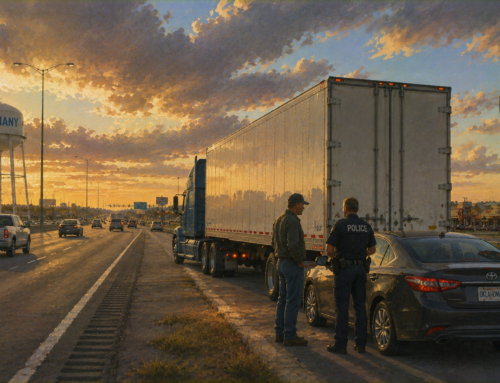
Perry sits two miles east of Interstate 35, not directly on I-40 — but the phrasing here matters less than the reality Perry residents face regularly on the regional highways connecting Noble County to the broader freight network, including routes that link to I-40 through the Oklahoma City metro. Semi wrecks involving Perry-area drivers on these connecting corridors can be catastrophic, and what many victims don’t realize until it’s too late is that the evidence most critical to their case begins disappearing within hours of the crash.
If you or a family member were injured in a semi wreck near Perry, understanding what evidence matters — and how quickly it vanishes — may be the most important thing you read right now.
Why Perry-Area Highways See Serious Semi Wrecks
Perry’s position at the junction of US-64 and US-77, just two miles from I-35, places Noble County drivers regularly on routes that connect to major freight corridors serving the entire region. Contributing factors include:
- Commercial vehicle traffic connected to Ditch Witch and Charles Machine Works supplier and logistics routes through Perry
- Regional freight traffic using US-77 and US-64 to connect to I-35 and the broader interstate network
- Driver fatigue among operators on regional runs through north-central Oklahoma
- Agricultural transport vehicles sharing roads with commercial trucks during Noble County’s planting and harvest seasons
- Mechanical failures — brake and tire issues in particular — that become catastrophic when a loaded trailer is involved at highway speeds

The Evidence That Matters Most in Your Case
Semi wreck cases are evidence-intensive by nature — and the evidence that most directly establishes what happened and who is responsible is largely held by the trucking company. Here’s what needs to be preserved, and why each piece matters.
Electronic Logging Device Data
Federal regulations require commercial drivers to use ELDs recording driving time, rest periods, and location. This data can establish hours-of-service violations — one of the most common forms of negligence in trucking cases. It’s subject to automatic overwriting in as little as 30 days.
Event Data Recorder — The Truck’s Black Box
Most modern commercial trucks capture speed, braking, and steering inputs in the seconds before a collision. This can definitively establish whether the driver was speeding or failed to brake in time. Like ELD data, it has a limited retention window.
Onboard Camera Footage
Many carriers now equip trucks with forward-facing and cab-facing cameras. This footage operates on rolling overwrite cycles and can be permanently gone within 24 to 72 hours.
Driver Qualification and Hours-of-Service Records
These records can reveal patterns of negligent hiring, inadequate training, or prior safety violations connected to the trucking company’s liability.
Maintenance and Inspection Records
If a mechanical failure contributed to the crash, maintenance records showing deferred repairs or missed inspections can establish direct liability on the carrier or a third-party maintenance contractor.
Post-Accident Drug and Alcohol Testing
Federal law requires commercial drivers involved in serious accidents to submit to testing within specified timeframes — and verifying this was properly conducted and documented is essential.
How a Legal Hold Letter Stops the Clock
A legal hold letter is a formal written demand sent to the trucking company requiring them to preserve all records and data relevant to the accident. Once received, the trucking company is legally obligated to suspend routine destruction or overwriting of relevant records. Failure to comply constitutes spoliation of evidence — a serious legal violation with real consequences in court.
But a legal hold letter only works if it’s sent before the evidence is gone. That means engaging an attorney within days of the crash, not weeks.
The Trucking Company’s Response Team Is Already Working
Large carriers maintain rapid response protocols specifically designed for serious accident situations. Their investigators, legal teams, and insurance representatives can be actively working the case within hours — documenting the accident from a perspective designed to protect the company while injured victims are still receiving medical care.
What Compensation May Be Available
The injuries produced by semi wrecks are frequently severe, and the financial consequences extend well beyond immediate medical bills. Compensation may include emergency medical care, long-term rehabilitation, lost wages, pain and suffering, property damage, and future medical costs for permanent injuries. Because commercial carriers carry substantially higher insurance limits than individual drivers, total compensation is often significantly greater than in a standard car accident claim.
Talk to a Perry Semi Wreck Lawyer
The evidence in your case is at risk right now. Getting an experienced semi wreck attorney involved immediately is essential to building the strongest possible claim.
To learn more about how we help semi wreck victims across Perry and Noble County, visit our Perry semi wreck lawyer page.
If you’re ready to talk about what happened, request a free case review or call (405) 447-HURT today.

The attorneys at Aldridge Teasdale will:
-
Immediately conduct a coverage investigation so that you get all the compensation available to you;
-
Set up you claim with all applicable coverages;
-
Assist you with getting front of the line appointments with top notch medical providers;
-
Monitor your treatment by coordinating with your medical providers, collecting bills and records for you, and promptly evaluating your case;
-
Take witness statements and gather evidence needed to win your case, such as, police records, dash cam, officer statements, video surveillance in the area, etc;
-
Get you the compensation YOU deserve!