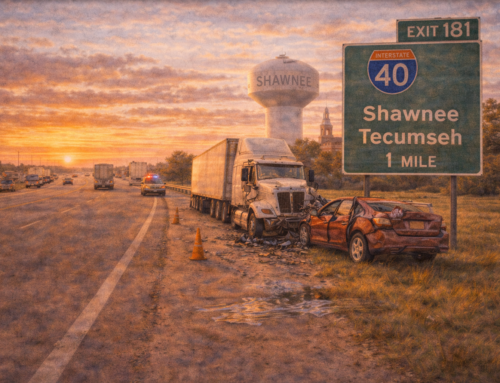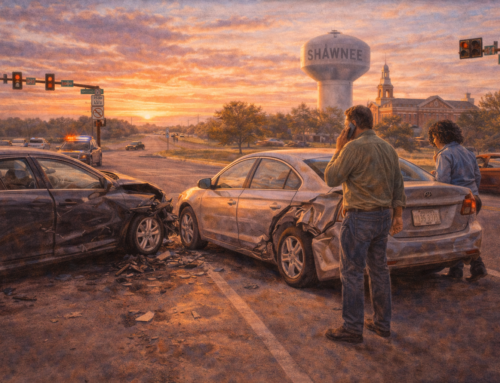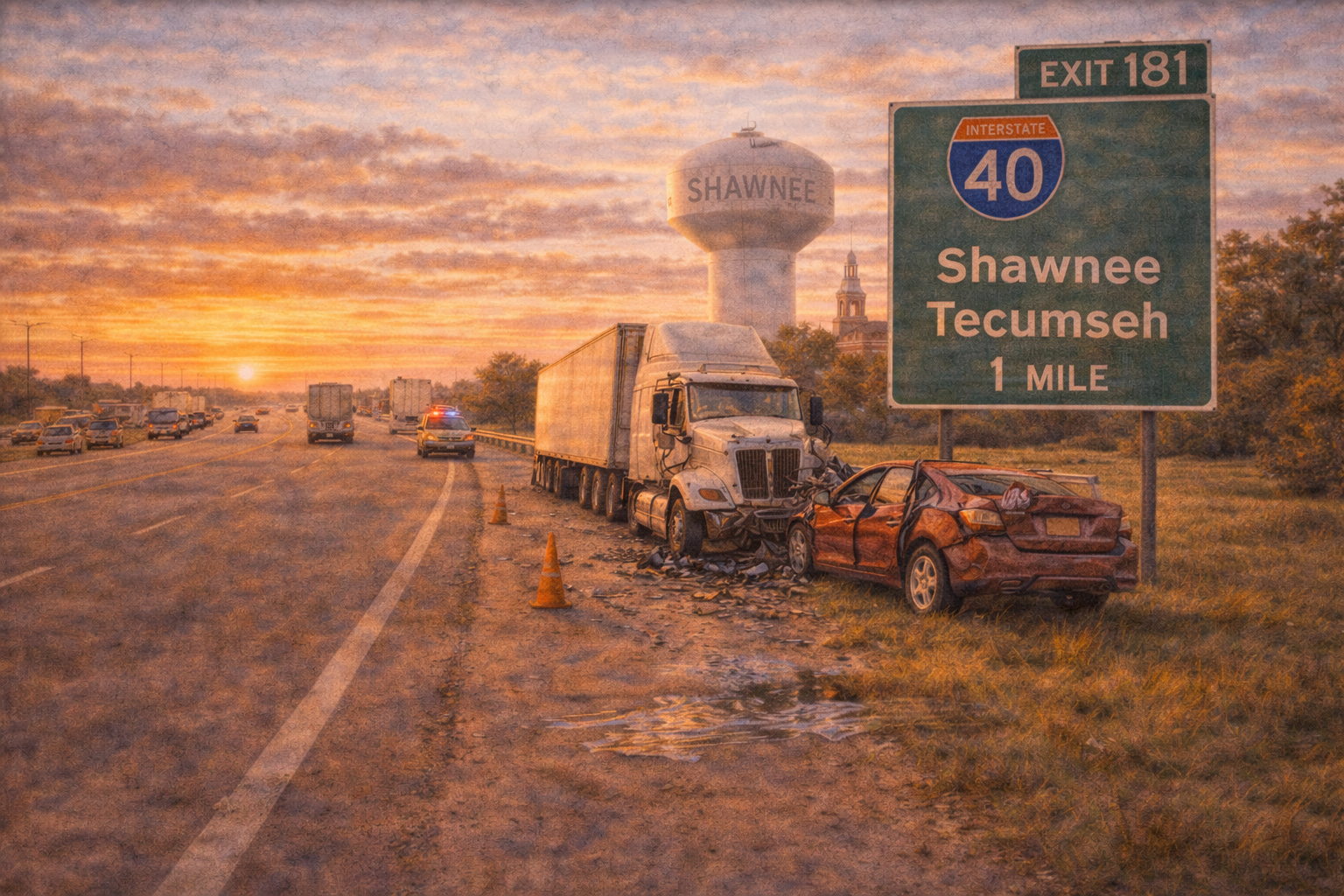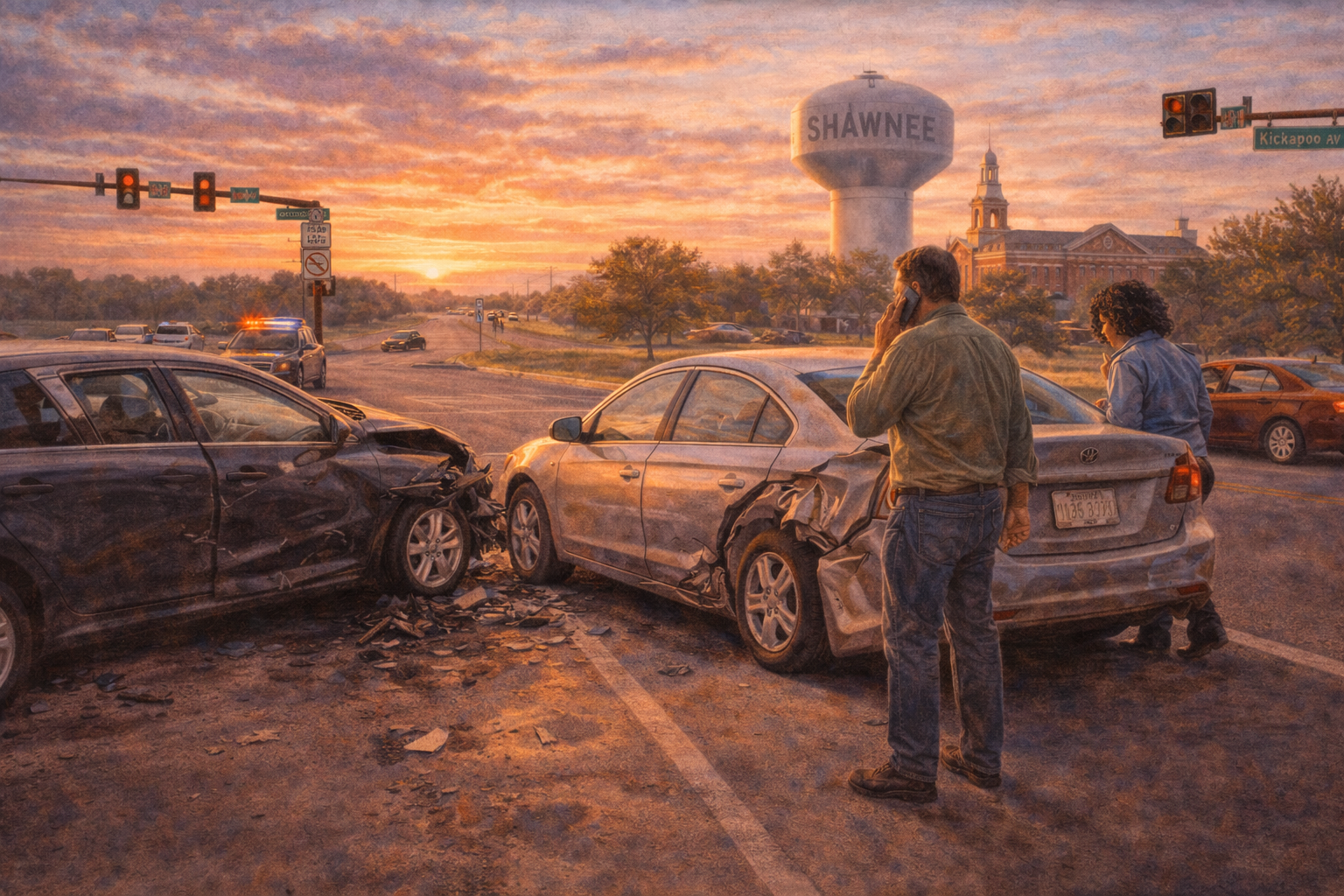
Interstate 40 runs directly through Pottawatomie County, and the stretch passing through and around Shawnee is one of the busiest segments of highway in eastern Oklahoma. For drivers navigating this corridor daily — whether commuting to Oklahoma City, traveling through on longer hauls, or navigating local interchanges — rear-end collisions are among the most frequent and most preventable accidents that occur here.
If you were rear-ended on I-40 near Shawnee, you may assume the case is straightforward. In many ways it is — but there are important steps to take and common mistakes to avoid that can significantly affect what you are able to recover.
Why Rear-End Collisions Are So Common on I-40 Near Shawnee
The I-40 corridor through Pottawatomie County presents conditions that make rear-end collisions a persistent and predictable hazard. The highway serves as a primary east-west route connecting Oklahoma City to the Arkansas border, carrying a constant mix of passenger vehicles, commercial trucks, and through traffic at sustained highway speeds.
Conditions that contribute to rear-end collisions near Shawnee include:
- Sudden traffic slowdowns near the Highway 177 and Highway 270 interchange areas where traffic patterns shift
- Distracted driving at highway speeds, where even a momentary lapse creates significant stopping distance problems
- Tailgating by drivers accustomed to open highway conditions who do not adjust when traffic slows
- Commercial truck traffic that requires significantly greater stopping distances than passenger vehicles
- Weather conditions including fog, ice, and rain that reduce visibility and road traction on open stretches of I-40
- Work zones that compress lanes and reduce speed limits with little warning for inattentive drivers
When a vehicle traveling at highway speed strikes a stopped or slowing vehicle from behind, the force involved frequently produces injuries that are far more serious than the visible vehicle damage might suggest.

Who Is at Fault in a Rear-End Collision
Rear-end collisions are among the clearest fault scenarios in personal injury law. Oklahoma follows a fault-based system for car accident claims, and in the vast majority of rear-end accidents the driver who struck the vehicle in front bears legal responsibility.
The legal principle is straightforward — every driver has a duty to maintain a safe following distance and pay attention to the road ahead. When a driver fails to stop in time and strikes another vehicle, that failure is generally considered negligence.
That said, fault in rear-end cases is not always absolute. Insurance companies representing the at-fault driver may attempt to argue:
- That the front vehicle stopped suddenly or without cause
- That the front vehicle’s brake lights were not functioning
- That a third vehicle’s actions caused the chain reaction
- That road or weather conditions were the primary cause
These arguments are rarely successful when the evidence is properly documented, but they are common tactics used to reduce the value of a claim. Having legal representation ensures these defenses are addressed effectively.
When a Rear-End Collision Involves a Commercial Truck
Rear-end collisions on I-40 near Shawnee frequently involve commercial trucks, and when they do the stakes — and the complexity — increase significantly. A fully loaded semi-truck traveling at highway speed requires exponentially more stopping distance than a passenger vehicle, and the force of impact in a truck rear-end collision can be devastating.
If a commercial truck rear-ended your vehicle on I-40, liability may extend beyond the driver to include:
- The trucking company, if driver fatigue, inadequate training, or unrealistic scheduling contributed to the crash
- A maintenance provider, if brake failure or other mechanical issues played a role
- A cargo company, if overloading affected the truck’s ability to stop safely
These cases require fast action to preserve electronic logging data, brake inspection records, and other evidence specific to commercial vehicle accidents.
Injuries Common in I-40 Rear-End Collisions
The abrupt force of a rear-end impact — particularly at highway speeds — places tremendous stress on the neck, spine, and surrounding structures. Even collisions that produce relatively minor vehicle damage can cause significant injury. Common injuries in rear-end collisions on I-40 include:
- Whiplash and cervical spine injuries that may not produce full symptoms for days after the crash
- Herniated or bulging discs in the cervical or lumbar spine
- Traumatic brain injuries from the head snapping forward and back or striking the headrest or steering wheel
- Shoulder injuries from seatbelt loading during impact
- Knee injuries from contact with the dashboard
- Fractures and soft tissue injuries throughout the body depending on the force involved
The delayed onset of symptoms in rear-end collision injuries is one reason why seeking medical attention immediately — even when you feel relatively okay — is so important. Gaps in medical care between the accident and the appearance of symptoms are a common tool insurers use to dispute the connection between the crash and your injuries.
Steps to Take After a Rear-End Collision on I-40
Whether the crash happened near a Shawnee interchange or on an open stretch of I-40 through Pottawatomie County, the steps you take in the immediate aftermath directly affect your claim:
- Call 911 and wait for law enforcement — a police report is essential documentation in any injury claim
- Move to a safe location off the roadway if possible before exchanging information
- Document the scene thoroughly with photos of all vehicles, their positions, visible damage, skid marks, and road conditions
- Collect the other driver’s insurance information, license plate, and contact details
- Gather witness contact information from anyone who stopped or observed the crash
- Seek medical attention the same day, even if injuries feel manageable
- Contact a personal injury attorney before giving any recorded statements to the at-fault driver’s insurance company
Talk to a Shawnee Car Accident Lawyer
A rear-end collision on I-40 may seem like an open-and-shut case — but insurance companies rarely make the process simple, even when fault is clear. Getting experienced legal representation ensures that the full value of your injuries, your lost time, and your ongoing recovery is properly accounted for in your claim.
To learn more about how we help injury victims across Shawnee and Pottawatomie County, visit our Shawnee personal injury lawyer page.
If you’re ready to talk about what happened, request a free case review or call (405) 447-HURT today.

The attorneys at Aldridge Teasdale will:
-
Immediately conduct a coverage investigation so that you get all the compensation available to you;
-
Set up you claim with all applicable coverages;
-
Assist you with getting front of the line appointments with top notch medical providers;
-
Monitor your treatment by coordinating with your medical providers, collecting bills and records for you, and promptly evaluating your case;
-
Take witness statements and gather evidence needed to win your case, such as, police records, dash cam, officer statements, video surveillance in the area, etc;
-
Get you the compensation YOU deserve!